Green Kitchen Cabinets in 2026: How to Choose the Right Shade, Finish, and Pairings
Green kitchen cabinets can feel calm, grounded, dramatic, or playful. The result depends less on whether green is “in” and more on four practical decisions: the undertone, the room’s light, the surrounding materials, and how much of the cabinetry will be green.
That distinction matters in 2026. The National Kitchen & Bath Association’s 2026 Kitchen Trends Report found that 86% of surveyed industry professionals identified green as a popular color family, behind neutrals at 96%. The same report found strong interest in natural light, quality lighting, and task lighting. Green clearly has design momentum, but no trend report can choose the correct finish for a specific kitchen.
The safest approach is to review green as part of the complete cabinet system: room orientation, countertop, flooring, backsplash, door style, finish sheen, storage plan, appliances, and the spaces visible from the kitchen. This guide shows how to do that before approving a sample or requesting a detailed cabinet quote.
Is green a good color for kitchen cabinets?
Yes—green can work in traditional, transitional, modern, organic, and mid-century-inspired kitchens. It can also bridge painted cabinetry and natural wood more easily than many highly saturated colors.
But “green” is not one decision. A muted sage may behave almost like a neutral. Olive can feel warm and earthy. Forest green has more visual weight. Blue-green can look crisp in one room and unexpectedly cool in another. A bright emerald or avocado finish can create a strong period or statement look.
Green is a good choice when:
- you have reviewed it beside the actual countertop, floor, backsplash, and hardware;
- the undertone works in both daylight and evening lighting;
- the amount of green fits the size and brightness of the room;
- the color supports the rest of the home instead of becoming an isolated theme;
- you are approving a physical cabinet finish sample, not relying only on a phone or computer screen.
If you like green but are unsure about committing to a full kitchen, use it on the island, lower cabinets, a beverage center, or one tall cabinet wall. These placements create a clear focal point while leaving more of the room in a quieter material or neutral finish.
What recent homeowner discussions reveal
Forum and social discussions are anecdotal, not statistical design evidence, but they are useful for identifying the decisions that repeatedly cause uncertainty. In recent kitchen-remodel threads, homeowners have focused on:
- a sage finish looking noticeably bolder after the cabinets moved into a room with different lighting;
- under-cabinet and overhead lighting changing how the finished green is perceived;
- whether to use green everywhere or limit it to one cabinet zone;
- black versus brass hardware;
- cool green clashing with warmer flooring, lighting, or wood.
These concerns appear in recent homeowner discussions about lighting changing a sage cabinet finish, the effect of under-cabinet lighting and hardware, and the risk of using too much cool green beside warm materials. A May 2026 Houzz review of four new green kitchens similarly emphasizes green paired with wood, stone, brass, and restrained neutrals.
The practical takeaway is not to choose the color that receives the most social approval. Use those discussions to identify what needs to be tested in your own room.
Start with the room, not the color swatch
A small sample viewed in a showroom or on a screen cannot predict how an entire wall of cabinetry will look. Before shortlisting a shade, document the room conditions that will influence it.
1. Check the direction and timing of natural light
Natural light changes color throughout the day. Sherwin-Williams’ guidance on room orientation notes that north-facing rooms tend to receive cooler light, south-facing rooms receive warmer light, and east- or west-facing rooms can change noticeably from morning to evening.
The principle is useful for cabinetry, but a cabinet finish is not identical to wall paint. Substrate, coating system, sheen, and vertical versus horizontal surfaces can all affect the final appearance. Use room orientation to narrow the direction, then test an actual sample door in the space.
Take photos or notes at three times:
- morning daylight;
- the brightest part of the day;
- evening with the kitchen lights on.
If the kitchen receives little daylight, record the bulb color temperature and where the task lights, pendants, and under-cabinet lights will be placed.
2. Measure the visual weight of the cabinet plan
A dark green island in a bright open kitchen is not the same design decision as dark green floor-to-ceiling cabinetry in a narrow galley. Review:
- the number of upper cabinets;
- the length of tall cabinet or pantry walls;
- whether appliances are panel-ready;
- ceiling height;
- the size and position of the island;
- how much wall and backsplash will remain visible.
The more continuous cabinet surface the room has, the more strongly the color will influence perceived brightness and visual weight.
3. List the fixed finishes
Start with materials that are already installed, already purchased, or expensive to replace:
- flooring;
- countertop;
- backsplash;
- window frames;
- large appliances;
- nearby wood finishes;
- stone or fireplace surfaces visible from the kitchen.
These fixed finishes create the boundary for the green. A cabinet color should be selected with them, not added after them.
4. Look beyond the kitchen
Open-plan kitchens are viewed from dining and living spaces. Hold the sample where the cabinets will be seen, then step into adjacent rooms. A green that looks balanced beside the countertop may still conflict with a nearby sofa, built-in, wall color, or wood species.
Choose a green family before choosing an exact color
Instead of collecting dozens of paint names, start with a color family. Each family produces a different relationship with light, wood, stone, and hardware.
| Green family | General character | Often works with | Main risk to check |
|---|---|---|---|
| Muted sage or gray-green | Quiet, soft, low-contrast | White oak, warm white, light quartz, brushed nickel or aged brass | Can look flat or too gray in weak light |
| Olive or earthy green | Warm, grounded, organic | Walnut, creamy stone, terracotta, bronze or brass | Can turn yellow or muddy beside the wrong beige |
| Forest or deep green | Rich, architectural, high-impact | Light stone, medium wood, brass, black, strong task lighting | Can feel heavy when used on too much cabinetry |
| Blue-green or teal | Crisp, tailored, distinctive | Cool white, gray stone, walnut, nickel or black | Can look colder than expected in north-facing light |
| Bright or retro green | Playful, expressive, period-specific | Simple counters, restrained walls, selected vintage details | Can dominate the room and date more quickly |
This table is a starting point, not a universal pairing formula. Natural materials vary. Quartz, marble, quartzite, wood, tile, and metal can each carry warm or cool undertones that are not obvious in a product name.
Muted sage and gray-green cabinets
Sage green kitchen cabinets are popular because they can act like a colored neutral. They tend to work well when the design needs softness rather than contrast.
Use sage or gray-green when you want:
- a relaxed transition between painted cabinets and natural wood;
- a low-contrast kitchen with warm whites and light stone;
- color that can extend into a pantry, mudroom, or built-in without becoming too dominant.
Watch for gray-green finishes that lose their green identity under cool or weak light. Compare the sample with a true neutral and with the floor so the undertone is easier to see.
Olive and earthy green cabinets
Olive contains more yellow or brown influence than a blue-green. It can sit comfortably beside walnut, aged metals, creamy stone, and warm tile.
Olive is strongest when the room already has an earthy material story. It is less predictable when paired with pink-beige tile, red-toned wood, or strongly yellow artificial light. Build a physical sample board before approving it.
Forest and dark green cabinets
Dark green kitchen cabinets can give a kitchen architectural depth. They are especially effective on an island, a beverage station, or a tall cabinet wall where the color can read as one intentional volume.
Dark green needs a lighting plan. Consider:
- task lighting on work surfaces;
- under-cabinet lighting where uppers remain;
- lighter counters or backsplashes to create separation;
- enough contrast between door fronts, pulls, and appliances;
- whether the color will continue onto end panels, fillers, crown, and toe kicks.
A dark finish does not automatically make a small kitchen unusable, but large areas of dark cabinetry without adequate light or contrast can make the room feel visually compressed.
Blue-green and teal cabinets
Blue-green can feel clean and contemporary, especially on slab or narrow-rail Shaker doors. It often coordinates with cooler stone, stainless steel, nickel, matte black, and selected walnut tones.
Because blue-green can shift significantly under different light sources, test it in the actual room. A sample that feels balanced in daylight may become more blue or more saturated under evening lighting.
Bright, emerald, mint, and avocado greens
These finishes are best treated as deliberate statements rather than default neutrals. They can be right for a mid-century, eclectic, or highly personalized kitchen, but the rest of the palette needs restraint.
If you want a stronger green:
- consider using it on one cabinet zone;
- keep the countertop and major wall surfaces relatively simple;
- repeat the color sparingly elsewhere;
- confirm that the choice works with the architecture of the home, not only with an inspiration image.
Decide how much green the kitchen needs
The placement of color may matter as much as the exact shade.
Option 1: Green on all cabinets
This creates the strongest identity and the most consistent finish. It works best when the room has good light, the undertone is carefully coordinated, and the cabinet elevations have enough variation from windows, open areas, counters, or appliances.
Option 2: Green lower cabinets with lighter uppers
This grounds the lower half of the room while preserving brightness near eye level. It can be useful in kitchens with limited daylight or many upper cabinets.
The transition should be intentional. Confirm which finish will apply to:
- tall pantry units;
- refrigerator panels;
- side panels;
- crown and light rail;
- island cabinetry;
- floating shelves.
Option 3: Green island or feature zone
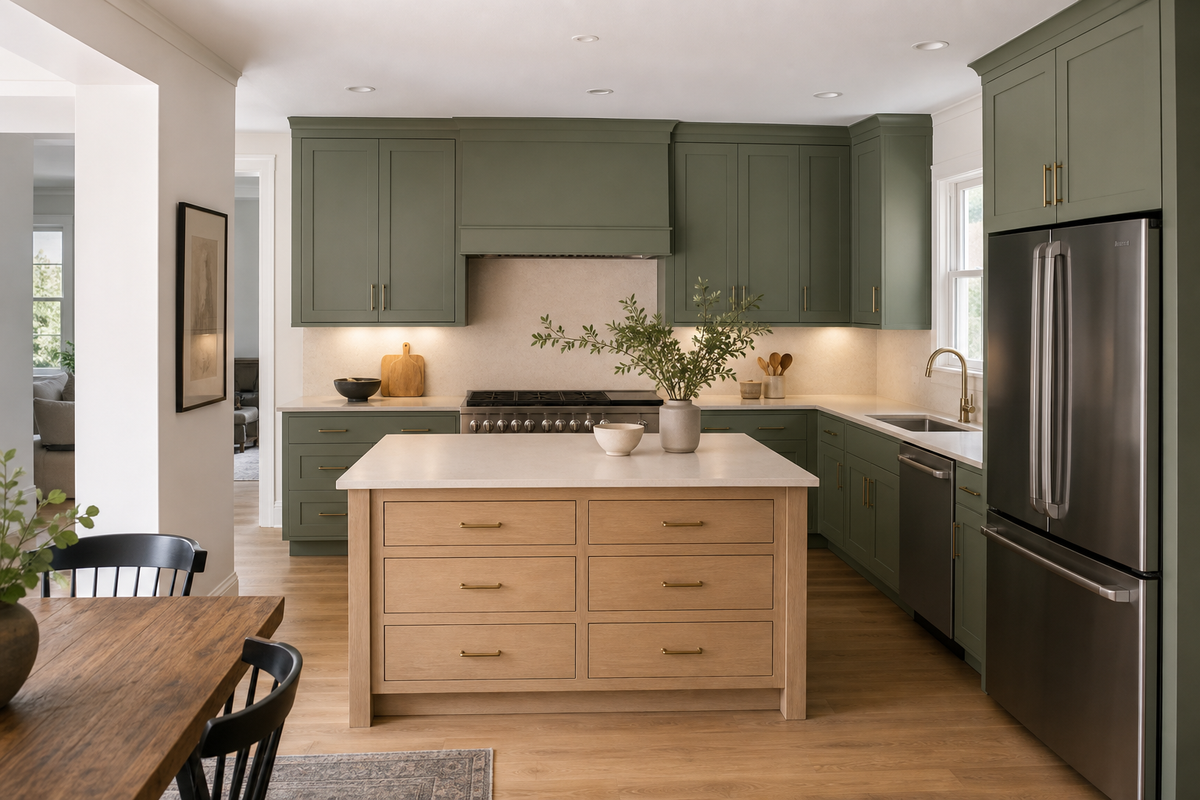
An island, coffee bar, beverage center, or pantry can carry the stronger color while the perimeter remains wood or neutral. This is often the most flexible choice for homeowners who want green without making it the background of every view.
Option 4: Green plus natural wood
A green and wood kitchen can feel warm and layered, but the wood species and stain matter. White oak, walnut, and red-toned woods do not behave the same way. Review the actual wood sample beside the green finish, then check both against the flooring.
How to pair green cabinets with the rest of the kitchen
Countertops
White and light countertops are common with green cabinets because they create contrast, but “white” can be warm, cool, bright, creamy, or heavily veined.
- Warm white or cream may suit sage and olive.
- Crisp white can sharpen a dark or blue-green palette.
- Warm gray or greige stone can reduce contrast.
- Strong veining should be reviewed at full slab scale because a small sample may not show the dominant movement.
Do not choose the cabinet color and countertop in separate meetings if you can avoid it.
Backsplash
The backsplash sits directly beside both the cabinet and countertop, so even a small undertone conflict becomes visible. Simple tile can calm a strong cabinet color. Patterned tile can work, but the room then has two focal elements competing for attention.
For slab backsplashes, review the full vein direction and the locations of outlets, shelves, windows, and hood details before final approval.
Flooring and wood
Wood introduces color through species, cut, stain, grain, and finish. A pale white oak can make a muted green feel organic, while dark walnut can add contrast and formality. Red or orange floors need more careful testing with yellow-based greens.
When the kitchen floor is already installed, treat it as a fixed finish. Bring the cabinet sample to the floor instead of judging the two from separate product photos.
Walls and ceilings
Warm white is not automatically right for every green, and cool white is not automatically cleaner. Compare the wall paint with the cabinet door and countertop. If the green will cover most of the room, the wall may need to stay quiet. If green is limited to the island, the wall can carry more of the palette.
Hardware and plumbing finishes
Brass can warm green, nickel can keep it crisp, and black can create graphic contrast. None is universally best.
Hardware also needs to work as a functional system. Confirm:
- pull length and proportion;
- knob versus pull placement;
- clearance at corners and appliance panels;
- finish consistency with faucets, lighting, and visible appliance details;
- whether touch points will show fingerprints or wear.
Door style, material, and sheen change the color
An exact color name does not guarantee an exact visual result across different cabinet constructions.
Door style
- Slab doors show color as a large, uninterrupted field and can make saturated greens feel stronger.
- Shaker doors create shadow lines around the center panel, adding depth and reducing the sense of one continuous color block.
- Raised-panel or detailed doors create more highlights and shadows, which can make a dark finish feel traditional or formal.
Material and coating system
Painted wood, painted MDF, veneer, laminate, melamine, and lacquered surfaces have different seams, texture, edge construction, movement, touch-up options, and maintenance needs. Ask what the approved sample represents and whether the production door will use the same substrate and finish system.
Use the Last Closet Materials, Finishes, Hardware, and Certification Guide to compare the decisions that affect appearance, durability, cleaning, hardware load, and quote accuracy.
Sheen
Matte, satin, and high-gloss surfaces reflect light differently. Higher reflection can make a color feel brighter and reveal more fingerprints or surface variation. Matte finishes reduce glare but can respond differently to cleaning and touch depending on the coating.
Do not approve sheen from a color chip. Request a representative finished sample.
Use a sample-review workflow before ordering
The goal is not to find a green that looks good once. It is to find a cabinet finish that stays coordinated across the room’s normal conditions.
Step 1: Build a fixed-finish board
Gather the actual or representative samples for:
- countertop;
- backsplash;
- flooring;
- nearby wood;
- wall paint;
- hardware and plumbing finish.
Step 2: Shortlist two or three green families
Avoid comparing ten nearly identical colors. Choose a warmer option, a cooler option, and—if appropriate—a lighter or darker option.
Step 3: Request representative cabinet samples
A finished sample door is more useful than a printed card because it shows the substrate, profile, coating, edge, and sheen. Confirm that the sample is representative of the production specification.
Step 4: Review the samples in place
Place samples vertically where base, upper, island, and tall cabinets will appear. Review them in morning, midday, and evening light. Photographing the samples can help document the process, but the final decision should be made with the physical sample.
Step 5: Check adjoining views
Stand in the dining room, living room, and main entry into the kitchen. Make sure the green relates to the finishes already visible from those spaces.
Step 6: Record the approval
The final approval should identify more than a color name. Record the finish code, substrate, door style, sheen, edge treatment, sample date, and the cabinet zones that receive it. Keep the approved sample available for comparison.
Color cannot replace a functional cabinet plan
A green kitchen still needs the right layout. Before finalizing color, confirm:
- appliance models and required clearances;
- sink, range, refrigerator, and preparation zones;
- drawer versus door storage;
- pantry and tall cabinet access;
- corner cabinet strategy;
- waste, recycling, tray, spice, and small-appliance storage;
- fillers, finished end panels, toe kicks, crown, and light rail;
- lighting channels and electrical coordination;
- delivery access and local installation conditions.
The NKBA 2026 report also points to growing interest in smarter storage and personalized lifestyle features. That is a useful market signal, but the correct storage plan must still come from the household’s actual cooking, access, and organization needs.
You can sketch an early kitchen, pantry, mudroom, or other cabinet concept with the Last Closet Cabinet Builder, then send it for review.
Do green cabinets affect cost or lead time?
They can, but the color alone does not determine the answer.
Cost and timing may change based on:
- standard versus custom finish;
- door material and profile;
- coating system and sheen;
- sample or strike-off requirements;
- number of finish changes in one project;
- matching requirements for panels, trim, fillers, and touch-up materials;
- special packaging or approval steps;
- cabinet volume, drawer ratio, hardware, organizers, and delivery scope.
An early quote should be treated as a range until dimensions, layout, materials, finish, hardware, and delivery requirements are defined. Review the Custom Cabinet Cost Guide before comparing proposals.
How should green kitchen cabinets be cleaned?
Follow the care instructions for the approved finish system. “Green” describes the color, not the material or coating, so one cleaning method should not be assumed to fit every cabinet.
As a general starting point:
- remove dust with a clean, soft, lint-free cloth;
- wipe cooking splatter and water promptly;
- use only the cleaner permitted by the cabinet manufacturer;
- dry damp surfaces rather than allowing moisture to remain;
- avoid abrasive pads, harsh solvents, bleach, and ammonia unless the finish manufacturer specifically permits them;
- test any unfamiliar product in an inconspicuous location.
MasterBrand’s public cabinet care guide, for example, recommends soft cloths, mild diluted dishwashing liquid when needed, and drying after cleaning. It advises against waxing or polishing its cabinetry. Other finish systems may have different instructions, which is why the project-specific care sheet should control.
Common mistakes to avoid
Choosing from a screen
Screens change color through brightness, calibration, compression, and ambient light. Use digital images for direction, not final approval.
Ignoring undertones
Two greens can appear similar until they are placed beside warm stone, cool tile, or red-toned wood. Compare materials together.
Testing only at noon
A finish that works in bright daylight may feel too cool, dark, or saturated under evening lighting.
Treating every surface independently
Cabinets, counters, floors, walls, backsplash, hardware, and lighting form one palette. A collection of individually attractive materials can still conflict when installed together.
Using too much of a dark color without a lighting plan
Dark green can be excellent, but cabinet coverage, task lighting, contrast, and ceiling height should be reviewed as one composition.
Approving a color name without a production specification
Color names are not enough. The substrate, coating, sheen, door profile, edge, and approved sample need to be documented.
Finalizing color before layout
Changing cabinet dimensions, appliance panels, tall units, or the island after color approval can change how much green the room contains. Establish the system first.
What to prepare for a green-cabinet design review
You do not need professional drawings to start. A useful first review can begin with:
- room dimensions or a floor plan;
- photos of every wall and the adjoining rooms;
- window locations and room orientation if known;
- appliance list and model numbers when available;
- countertop, floor, backsplash, and wall references;
- two or three green inspiration images;
- preferred door style and sheen direction;
- a description of current storage problems;
- delivery location, target timeline, and budget direction.
Use the Custom Cabinet Quote Checklist to organize the information that affects an early budget range and a later detailed quote.
Frequently asked questions
Are green kitchen cabinets timeless or trendy?
Green is a current, well-supported design direction, but no color is automatically timeless. Muted greens, natural materials, and controlled color placement may have more staying power than a highly saturated finish used across every cabinet. The architecture of the home and the quality of the complete palette matter more than the trend label.
Are sage green cabinets good for a small kitchen?
They can be. A lighter or muted sage may keep the palette soft, but room orientation, cabinet coverage, counter contrast, and artificial lighting still need to be checked. In a dark room, some gray-greens can appear dull rather than airy.
What countertop looks best with green cabinets?
There is no single best material. Light quartz, warm white stone, quartzite, marble, wood, and darker surfaces can all work. Compare undertones and view the actual slab or representative sample beside the cabinet finish.
Should green cabinets use brass or black hardware?
Brass often adds warmth; black adds contrast; nickel can feel cooler and quieter. Choose hardware with the faucet, lighting, appliances, door style, and surrounding metals—not from the cabinet color alone.
Can green cabinets work with stainless steel appliances?
Yes. Muted sage, forest green, and blue-green can all coordinate with stainless steel. Check whether the stainless finish reads cool or warm in the room and repeat the metal intentionally through hardware or fixtures if appropriate.
Should I choose painted wood or painted MDF doors?
The right choice depends on door construction, humidity, desired edge and joint appearance, coating system, repair expectations, budget, and the manufacturer’s specification. Compare representative samples and written construction details rather than assuming one material is universally superior.
How can I keep dark green cabinets from feeling too heavy?
Limit the dark finish to an island or lower cabinets, reduce continuous upper cabinetry, use lighter counters or backsplashes, protect natural light, and include layered task lighting. A full elevation review is more reliable than choosing by room size alone.
Do I need a full sample door?
For a high-commitment custom cabinet finish, a representative sample door is preferable. It shows the profile, substrate behavior, coating, sheen, edge, and shadow lines more accurately than a small paint chip.
Plan the green as part of the complete cabinet system
The best green kitchen is not the one with the most fashionable color name. It is the one in which the cabinet finish, room light, fixed materials, door construction, storage plan, and adjoining spaces have been reviewed together.
Last Closet provides remote cabinet planning support for U.S. homeowners, designers, and contractors. Final field measurements and on-site installation should be coordinated with the appropriate local professional. When you are ready, send your project details, including room photos, dimensions, material references, storage needs, and your preferred green direction, so the cabinet system can be reviewed at the right quote stage.
Sources and editorial notes
- NKBA — 2026 Kitchen Trends Report Press Release
- Sherwin-Williams — Choosing Color Based on Room Orientation
- MasterBrand — The Homeowner's Guide to Care and Cleaning
- Houzz — 4 Stylish New Kitchens Featuring Green Cabinets
- Last Closet’s recommendations in this article are planning guidance. Final colors should be approved with representative physical samples, and field conditions should be verified before production.
- All six article images are original AI-generated planning visualizations. They are not completed Last Closet projects, manufacturer color standards, or substitutes for physical samples.